How Wind Pressure Reports Quietly Became Part of the Workflow at WindSketch
- Home
- How Wind Pressure Reports Quietly Became Part of the Workflow at WindSketch


Jamie McKinsey
May 27, 2026
For years, wind pressure reports lived in a separate universe from the rest of the project.
A contractor could measure a home, build the estimate, draw the openings, discuss products with the homeowner, prepare permitting documents — and still find themselves pushed into a completely different process once wind pressure analysis entered the picture. Different systems. Different people. Different timelines.
It became normal to wait days for answers.
Normal to overestimate pressures just to stay safe.
Normal to discover late in the process that certain openings required stronger products than originally planned.
The industry adapted to that friction because it had little choice.
But something interesting has started happening inside WindSketch.
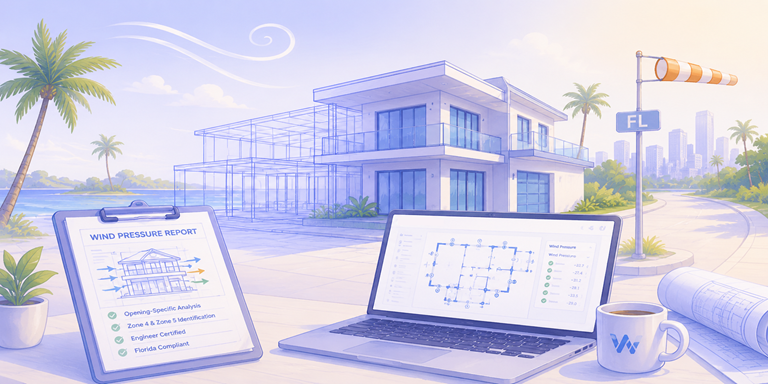
Companies are beginning to generate opening-specific wind pressure reports directly from the same environment where the project itself is already being created. Not as a disconnected engineering request sent somewhere else, but as part of the natural progression of the job.
We recently published a video showing that process in real time.
The video is straightforward on purpose. No elaborate presentation. Just the actual workflow — creating a project, defining openings, generating the report, and moving toward permitting without leaving the platform.
What makes the experience feel different is not only the speed. It is the continuity.
By the time a project reaches the wind pressure stage inside WindSketch, much of the building intelligence already exists. The geometry has already been defined. The openings are already mapped. The structure already contains information that, traditionally, had to be re-entered manually into another system entirely.
That changes the nature of the workflow itself.
Instead of treating wind pressure analysis like a detached engineering event, the platform treats it as another layer of the same project.
The effect is subtle at first. Then operationally significant.
Teams spend less time repeating information. Fewer assumptions have to be made manually. Zone calculations that once depended heavily on interpretation can now be analyzed directly from the structure being drawn. Even environmental and dimensional data that historically required additional lookup steps can often be inferred automatically from the project location and building characteristics.
Behind the scenes, the system combines project geometry, geospatial data, and engineering logic to reduce the amount of manual input required from the contractor.
But the goal was never to automate engineering judgment out of the process.
Every report generated through the platform is still reviewed and signed by licensed engineers. The difference is that the tedious parts surrounding that process have been dramatically reduced.
The reports themselves are opening-specific and currently available for $40 per report, a price point intentionally designed to make certified analysis more accessible to replacement companies handling projects at scale.
That accessibility matters because one of the industry’s hidden inefficiencies has always been conservatism born from uncertainty. When pressure requirements are discovered late, companies often end up adjusting products, revising estimates, or sacrificing margins to keep projects moving.
WindSketch shifts part of that visibility earlier into the process.
Before certification even happens, teams can already begin validating assumptions directly inside the project workflow. In practice, that can mean fewer surprises during permitting and better alignment between estimating, product selection, and engineering requirements.
And perhaps that is the larger story here.
Not that wind pressure reports became faster.
But that they became quieter.
Less disruptive. Less detached from the rest of the work. Less like a bottleneck sitting outside the workflow waiting to slow everything down.
In an industry where time disappears into small operational frictions, that kind of change tends to matter more than people initially realize.

Jamie McKinsey is the SDR Manager at Windsketch, leading the sales team with passion and strategy. With a background in business development and lead generation, she focuses on optimizing processes to maximize booked demos. Her people-centered approach and results-driven mindset have been key to driving the company’s growth in the window and door solutions industry.