The Hidden Cost of Running a Window Company Across Five Different Systems
- Home
- The Hidden Cost of Running a Window Company Across Five Different Systems


Jamie McKinsey
July 23, 2026
Window and door contractors are discovering that the real advantage of better software is not simply working faster. It is having the entire company operate from a single, reliable source of truth.
At the end of a busy afternoon, a window and door contractor needs to review the status of a project. The task should take only a few seconds. Instead, they open the project management system, check a spreadsheet for pricing, and search for the latest estimate, which may be saved as a PDF inside an email thread or scattered somewhere in a Google Drive folder. Installation photos are stored in a text-message or WhatsApp conversation. Permit documents are kept in a shared folder, and the person who knows the current status of the project may have already left for the day.
The information exists. The problem is that it is everywhere.
For years, this has been a common way of operating in the window and door industry. Companies have gradually assembled their technology: one program for customers, another for estimates, another for drawings, and separate tools for communication, accounting, permits, and documentation. During WindSketch demos, customers consistently describe this familiar combination of spreadsheets, improvised drawings, calls to manufacturers, and disconnected processes that undermine their company’s agility.
Each tool may solve a specific problem. Together, however, they create a much larger one.
A window or door project is not a collection of unrelated tasks.
Property measurements influence the sketch. The sketch determines the openings. The openings affect the products, pricing, and estimate. The accepted proposal influences purchasing, permitting, installation, and invoicing. Photos, documents, approvals, and conversations create the record that connects every stage.
When these stages are managed through different systems, employees must repeatedly enter the same information, search for missing files, and try to determine which version is the most current. Details are lost during handoffs between departments. Small misunderstandings become delays. Company leaders have difficulty identifying where projects are slowing down.
WindSketch was designed around a different idea: the entire lifecycle of a window and door project should remain connected.
The company creates the customer and project once. From there, the team can build the property map, identify openings, prepare estimates, create different proposal options, collect approvals, manage documentation, attach permits, and follow the project through every operational stage.
The project does not restart every time it reaches another department. Its information travels with it.
Generic business software can store a customer’s name, phone number, and address. However, it does not necessarily understand what happens after a customer requests 14 impact windows, two sliding doors, and three different product options.
WindSketch was built specifically for companies that sell and install windows, doors, and related products. Its estimating environment connects property mapping, openings, product configurations, custom pricing, parts, elevations, proposal versions, and accounting workflows. It also supports role-based access, allowing different employees to work within the same project while seeing only the information and actions relevant to their responsibilities.
This specialization matters because window and door companies have pricing structures that rarely fit into a simple template. Products may be calculated by unit, size, area, configuration, manufacturer, or a combination of several conditions.
WindSketch keeps all that complexity beneath the surface. Its pricing system can adapt to different manufacturers, materials, and pricing models while providing a straightforward workflow for the person preparing the estimate.
This reflects the platform’s two core principles: power and simplicity.
The software must be powerful enough to support the real needs of a growing contractor. But the employee using it should not need to understand the technical machinery operating underneath.
In many companies, a sketch is created for a specific purpose and then abandoned.
In WindSketch, the information represented in that sketch can continue to be used throughout the project. The same openings and geometry can support the estimate, proposal options, elevations, permit documentation, and wind-pressure reports.
Wind-pressure reports, for example, have historically been treated as a separate technical process. WindSketch has brought them into the same project environment, reducing repeated data entry and allowing each report to remain connected to the openings and geometry used to create it.
This continuity changes the purpose of the initial drawing. It is no longer simply an illustration for the homeowner. It becomes part of the company’s operational data.
The result is not only a faster estimate. It is a more reliable chain of information, from the first visit to the completed installation.
As a window company grows, the owner can no longer remain personally involved in every estimate, permit request, and installation-related conversation.
Growth creates a new requirement: visibility.
Executives need to know how many projects are being created, how many estimates are being produced, which jobs are advancing, and which are stalled. They need to identify where bottlenecks are forming and determine whether a delay is an isolated case or is becoming a pattern.
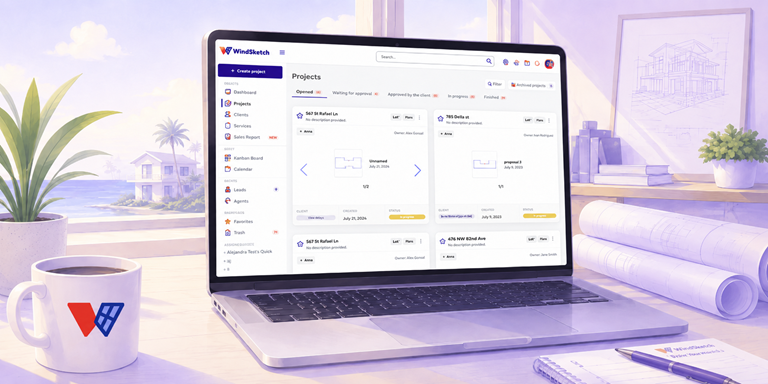
WindSketch gives company leaders a real-time view of projects, estimates, statuses, and activity across the organization. Projects can move through defined stages, while permissions, notifications, and responsibilities help different departments coordinate their work.
This allows managers to answer operational questions using current information instead of waiting for the next meeting or assembling reports from several applications.
The value becomes especially clear when something goes wrong with a project.
Instead of asking several employees what they remember, a manager can review the project’s history: when the estimate changed, which documents were added, what the team discussed, and why a particular decision was made.
Most communication platforms organize conversations around people or channels. WindSketch organizes communication around the project itself.
Its Activity Feed keeps conversations, updates, and shared context inside the corresponding job. Behind it, an Activity Log records important system events, including status changes and estimate modifications.
Together, they preserve both sides of the project’s story: what happened and why it happened.
Six months later, an authorized team member can return to the project and review its photos, communications, documents, approvals, permits, and operational history without having to reconstruct events from memory.
This record is useful for customer service, internal accountability, and employee transitions. It also protects the company when there is a disagreement about the products selected, the scope approved, or the work requested. In WindSketch, precise maps and project documentation create a shared reference for sales teams, production departments, installers, and homeowners.
Documentation stops being paperwork created after the fact. It becomes part of how the business operates.
Our customer stories show what happens when these disconnected stages are brought together.
O’Donnell Impact Windows & Storm Protection previously combined estimating software with Excel and reported that some estimates could take up to 72 hours. After moving its mapping and estimating workflows into WindSketch, the company said revisions became easier, estimates could be produced in minutes, and its closed deals increased by 22 percent during the following year.
Doors & Plus was paying approximately $2,000 per month to an outside engineer to prepare plans and elevations. After beginning to produce those materials internally through the platform, the company reported reducing a process that once took several days to one that could be completed in minutes.
The important lesson is not that every company will achieve exactly the same results. The lesson is that operational improvements compound.
A faster estimate helps the salesperson. A reusable project map helps the permitting team. Centralized communication helps the installer. Better visibility helps management. Complete documentation helps everyone when questions arise later.
Each improvement strengthens the next stage.
Replacing several applications with a single platform can reduce software expenses. However, consolidation alone is not the most important benefit.
The greater advantage is continuity.
When customer information, project geometry, estimates, documents, communications, and operational status remain connected, the company spends less time transferring information and more time moving the project forward.
For this reason, a growing number of window and door contractors no longer see WindSketch as simply another tool in their technology stack.
They are using it as the place where the entire business operates.
Because when every department works from the same project, a simple customer question no longer requires opening five applications and making three phone calls.
The answer is already there.
Bring your customers, estimates, projects, documents, and operations together in one place. Discover what your company can accomplish when the entire team works from one connected platform.

Jamie McKinsey is the SDR Manager at Windsketch, leading the sales team with passion and strategy. With a background in business development and lead generation, she focuses on optimizing processes to maximize booked demos. Her people-centered approach and results-driven mindset have been key to driving the company’s growth in the window and door solutions industry.