WindSketch Launches Project Activity-Feed: A New Communication Layer Built Directly Into the Workflow
- Home
- WindSketch Launches Project Activity-Feed: A New Communication Layer Built Directly Into the Workflow


Jamie McKinsey
May 14, 2026
Software in the window and door replacement industry has traditionally focused on solving highly technical problems: floor plans, takeoffs, measurements, estimating, permitting, engineering documentation, scheduling, and production coordination.
At WindSketch, we have spent years investing deeply in those operational layers because they matter. Accurate measurements matter. Permit-ready documentation matters. Wind pressure calculations matter. Precise project mapping matters.
But as our platform grew inside real companies operating at scale, another reality became increasingly clear.
Projects were moving faster than communication systems could keep up.
Not because companies lacked communication tools, but because most communication still lived outside the project itself.
Critical conversations were happening through text messages, Slack channels, emails, phone calls, disconnected CRMs, or verbal discussions in the office. Teams constantly had to jump between systems just to understand the context behind a project decision.
A salesperson uploads new measurements.
A project manager requests revisions.
An installer asks a question from the field.
A permit coordinator needs clarification.
An owner wants visibility into what changed.
The information existed — but the context was fragmented.
That observation led to the creation of Project Activity-Feed.
This week, WindSketch officially launched a completely new communication layer integrated directly inside every project.
The goal was not to create “another chat.”
The goal was to build a project-native communication system specifically designed for the operational realities of window, door, and shutter replacement companies.
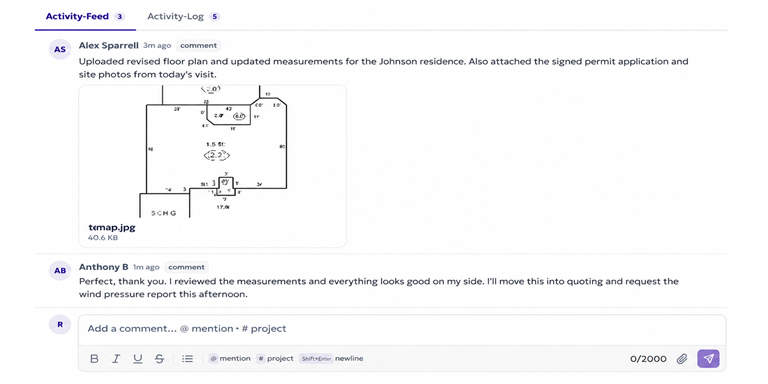
Inside the new Activity-Feed, teams can communicate in real time without leaving the project environment. Users can write updates, reference team members, mention departments, attach context directly to project discussions, and coordinate operational activity where the work is actually happening.
More importantly, the system was architected from the beginning to evolve beyond simple messaging.
WindSketch is already extending the Activity-Feed to support references to tasks, project entities, windows, doors, shutters, schedules, and even external calendar systems like Google Calendar. The vision is to create a communication environment where conversations are deeply connected to the operational objects inside the project itself.
Instead of saying:
“Can someone check Window 14 in the master bedroom?”
Teams will eventually be able to reference the exact opening directly inside the conversation thread.
Instead of searching through emails for a scheduling discussion, users will be able to reference actual calendar events tied to the project timeline.
Instead of disconnected operational notes, the communication layer becomes structurally aware of the project.
That architectural decision changes how information moves inside a company.
One of the most important aspects of the launch is that the Activity-Feed was intentionally designed as a complement to the existing WindSketch Activity-Log system — not a replacement for it.
The distinction is critical.
The Activity-Log is immutable. It automatically generates a historical timeline of operational events across the project lifecycle. If a project changes status, if a customer is assigned, if a team member updates information, if an estimate is modified, the system records those actions automatically as part of the permanent project history.
The Activity-Feed serves a different purpose.
It captures the collaborative side of operations.
The discussions.
The coordination.
The decisions.
The clarifications.
The human communication surrounding the workflow itself.
Together, both systems create something much more powerful than either could independently: a complete operational narrative of the project.
One layer tracks what happened.
The other explains the context behind it.
From an engineering perspective, building the Activity-Feed required much more than adding comments to a database.
The challenge was designing a system capable of scaling into a future operational hub for the replacement industry.
That meant building an architecture flexible enough to support rich entity references, real-time collaboration, future AI-assisted workflows, deeper scheduling integrations, and structured project intelligence without compromising performance or simplicity for the end user.
The result is a system that feels lightweight in the interface while carrying a much deeper operational foundation underneath.
For growing replacement companies, that matters.
As organizations scale across multiple sales reps, coordinators, installers, estimators, permit teams, and project managers, communication itself becomes operational infrastructure. Information must move quickly, but it also needs to remain attached to context.
That is the problem WindSketch set out to solve with Activity-Feed.
Not by replacing the operational tools companies already depend on, but by creating a communication layer that lives directly beside them.
Because modern replacement operations are no longer just about generating estimates or creating drawings.
They are about coordination.
And coordination works best when communication is no longer separated from the project itself.

Jamie McKinsey is the SDR Manager at Windsketch, leading the sales team with passion and strategy. With a background in business development and lead generation, she focuses on optimizing processes to maximize booked demos. Her people-centered approach and results-driven mindset have been key to driving the company’s growth in the window and door solutions industry.